
I once spent the best part of a month researching side hustles without choosing a single one.
I had a notebook, real pages with real ideas in it. Freelancing on one page. Consulting on another. A little course I could make. Something with digital products. I’d watched the videos, read the articles, and yes, I’d even asked an AI what it thought. By the end I knew a great deal about my options, and I’d earned precisely nothing from any of them.
If you’ve done something similar, I want you to know it isn’t a fault in you. It’s what happens to sensible people when there are too many choices and real money is riding on getting it right.
And that last part matters more than it used to. If you’re in your fifties or sixties, and work has recently dried up or slowed down, you’re not after a fun little hobby for the evenings. You need a bit of income, ideally before too many more months slip by. That quietly changes how all the researching feels.
Researching feels like progress. That’s the trap.
There’s nothing wrong with looking into something before you commit. If you spent decades in a proper job, careful checking probably feels like second nature. You wouldn’t have made a big decision at work without understanding the options first, so of course you do the same here.
So you ask the questions. Could I freelance? Could I consult? Could I turn what I know into a small course? Could I make a bit from a hobby I already enjoy?
Every question throws up another possible route, and every route comes with its own pile of articles, videos and opinions. The problem was never a shortage of ideas. It’s the opposite. There are so many of them that choosing one starts to feel like a far bigger decision than it really is.
Here’s the honest bit, though. All that reading feels like you’re getting somewhere. It feels productive. But another ten hours of it won’t tell you the one thing you actually want to know, which is whether anybody will pay you. Only a real person can tell you that.
Your first choice doesn’t have to be your last
This is where a lot of side-hustle advice quietly does you harm. It tells you to find the thing. Your perfect niche. The business that matches your passions and your experience and your ideal week, the one you’ll still be happily running in five years.
That’s an enormous weight to hang on a first decision. No wonder people freeze.
So try setting it down for a moment. What if you weren’t choosing the side hustle you’ll do forever? What if you were just choosing one that’s sensible enough to test?
That’s a completely different question, and a much kinder one. You stop asking “is this definitely going to work,” which you can’t possibly answer from your armchair, and you start asking “is this worth a small try.” That second one you can answer today.
Don’t throw away thirty years because the internet likes shiny things
One of the odd things about looking for ways to earn online is how quickly it can make you feel like a beginner again.
You might have managed people, sorted out messes, kept demanding customers happy, handled budgets, trained younger colleagues, or spent years quietly getting very good at something. Then you land online and someone tells you the answer is to go and learn TikTok. And just like that, you feel as though you’re starting from scratch.
Except you’re not. Knowing how to work the latest app and being able to offer something another person will pay for are two completely different things, and it’s the second one that actually matters. You’ve spent a whole working life building it.
So instead of starting with “which side hustles are popular,” try starting with “what can I already do that solves a problem for someone else.”
Your answer doesn’t need to sound exciting. Honestly, a bit boring is often better. Someone who spent years running complicated projects could help a small business get a messy one back on track. Someone with decades of admin behind them could offer a proper virtual assistant service. A former manager could mentor. A keen gardener, cook or photographer might know things a beginner would gladly pay to have laid out simply. You’re not hunting for twenty options here. You’re looking for one that’s believable enough to test.
Watch out for the moving starting line
Here’s the other thing that keeps you stuck. You settle on an idea at last, and then the list of things you apparently must do first starts to grow.
Pick a niche. Choose a brand name. Buy a domain. Build a website. Make a lead magnet. Start an email list. Set up Facebook and Instagram. Learn a bit of advertising. And somewhere off in the far distance sits your first pound.
The idea itself might be perfectly good. The trouble is that the starting line keeps sliding further away, until earning anything feels like it’s months off.
I’ve written before about how a genuinely simple side hustle should let you find a customer, do the work and get paid with barely any tech at all. If you want that full test, it’s here: The Two-Tool Rule. For now, just notice the trap, then move the starting line back to where it belongs. Put it right in front of a possible customer.
If you’re thinking about consulting, could you speak to three people who might actually need it? If it’s freelancing, could you write one clear offer and put it in front of ten likely clients? If it’s a digital product, could you describe it to a few possible buyers before you spend three weeks building it? None of those will guarantee a sale. That’s not the point. They’ll tell you something a hundred more browser tabs never will.
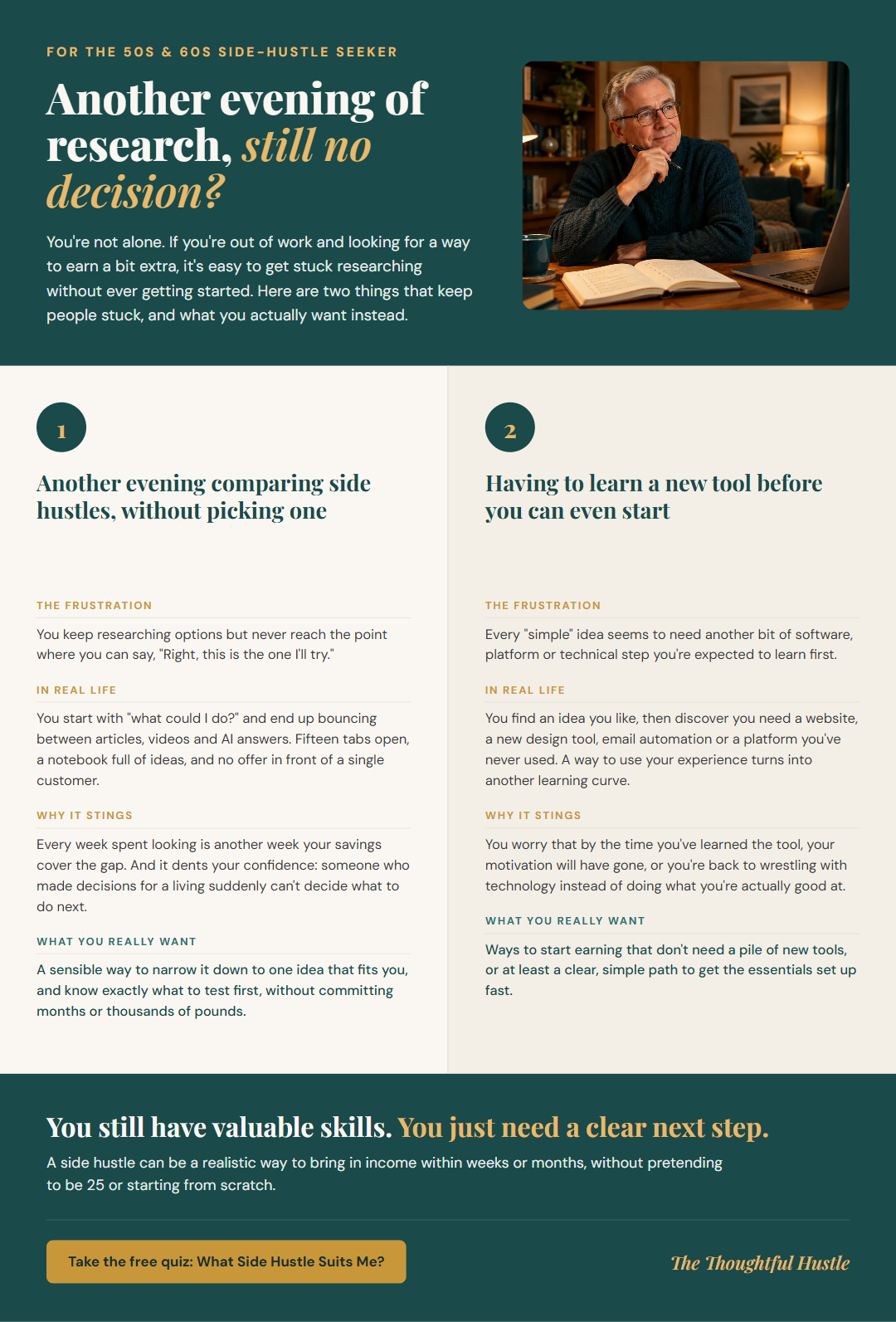
The job-hunting muddle makes it worse
There’s an extra knot in all this for anyone who’s recently lost a steady job.
You’re probably still applying for work too. A role comes up that fits you almost perfectly, so you update the CV again, fill in another form, retype things you’ve already typed a dozen times, write the covering letter, and press send. Then you wait. Maybe an automatic reply lands. Then nothing. A few days later another suitable role appears, and you do the whole thing again.
And you end up facing the same small, horrible question most mornings. Do I spend today applying for another job, or do I spend it trying to earn something myself?
There isn’t one right answer, and plenty of sensible people do both. But there’s a real difference between them that’s worth naming. With a job application, you’re waiting for someone else to pick you. With a small side hustle, you can make the offer yourself and see what comes back. After weeks of waiting on other people, that shift can do you a surprising amount of good.
Be careful what you buy while you’re stuck
This is also the moment when a £47, £97 or £297 course starts to look very tempting.
Sometimes one of those is exactly what you need. Sometimes it isn’t. The hard part is telling which. And if you’ve already got a couple of half-finished courses sitting in an inbox somewhere, your hesitation is completely fair. You’re not really wondering whether you can spare the money. You’re wondering whether it’ll actually move you towards earning, or just hand you another set of videos.
So here’s a simple test I use before buying any training. Work out what you’ll be able to do afterwards. Not what you’ll know. What you’ll actually do.
Will you have a service ready to offer? A product ready to test? A way of finding people who might buy? And what else will you still need before you can put it to use: another bit of software, a website, weeks of building an audience? If you can’t see a clear line from the training to a real action you’ll take, don’t let a countdown timer make the decision for you.
Swap “which one?” for “which one first?”
If this is you, and you’ve just lost another evening comparing options, here’s the one change I’d gently suggest. Stop trying to crown the winner.
Pick one reasonable candidate, ideally one that uses something you already know or already have. Then set yourself a small test. Not six months. Not two thousand pounds. Not a whole business. Just a test.
Say clearly what you’re offering. Work out who might pay for it. Find the simplest way to reach a handful of those people. Put the offer in front of them. Then watch what happens.
Maybe nobody bites. That’s useful. Maybe people are keen but not at the price you had in mind. Useful again. Maybe someone says, “I don’t need that, but could you help me with this instead?” Now things are getting interesting. Either way, you’re finally learning from real people, instead of from another article about real people.
You’re not starting again
Losing work later on can create an odd sort of collision. The money says move. The rejection and silence make you hesitate. The online world keeps waving new things at you to learn. And everywhere you look, someone is promising that their opportunity is the answer. Small wonder another evening vanishes into research.
But I don’t think you need twenty more ideas. I don’t think you need another course just yet. And you certainly don’t need to master every tool someone says a modern business must have.
You need one believable way to turn something you already know, or already do, into something another person might pay for. Then you need to test it. Your first go doesn’t have to become your new career. It only has to move you from thinking about earning to finding out what somebody will actually pay you for.
So if you’ve got fifteen side-hustle tabs open right now, here’s my suggestion. Close fourteen of them, and do something small with the one that’s left.
Not sure which one to keep open?
I built a short quiz for exactly this moment. It asks about your background and what you’d enjoy, then points you towards the kind of side hustle that tends to suit people in your position. It takes a few minutes, and there’s nothing to buy at the end of it.
And if you’d rather just think out loud, leave a comment below and tell me which idea you’re weighing up. I’m happy to help you work out the smallest way to test it.
Try this with AI
Want to narrow your own list down to one idea in five minutes? I do this all the time. Use whichever AI you already have (ChatGPT, Claude, Gemini, Copilot, or another). Swap the bits in brackets for your own details, then paste the whole thing in.
Act as a practical, honest side-hustle adviser for someone in their fifties or sixties who wants to earn a bit extra and is stuck choosing between too many ideas. Here is what I’ve got:
My background and skills: [list a few things you’ve done for work or as hobbies]. Ideas I’m considering: [list the side hustles you keep going back and forth on]. How much time I have: [rough hours per week].
Help me choose just one idea to test first, not the one I’ll do forever. Pick the single idea that best uses my existing experience and needs the least new learning to make a first sale. Explain in plain English why you chose it over the others.
Then design the smallest possible test I could run in the next two weeks. Tell me exactly what to offer, who to offer it to, and the simplest way to reach a few of those people and get paid. Keep the tools and cost to a bare minimum.
Don’t invent facts about demand, earnings or likely results. If you make a reasonable assumption, label it clearly as an assumption.
Affiliate disclosure: some course and resource links may be affiliate links. If you buy through one of them, I may receive a commission at no extra cost to you. I am fortunate not to depend on affiliate income, which gives me the freedom to be selective and recommend only resources I believe are genuinely useful.